The Creative Curriculum® for Pre-K - Criterion 1.1
Loading navigation...
Criterion 1.1: Responsive Practices
Curriculum materials are designed to facilitate positive relationships by being responsive to diverse identities and backgrounds.
Indicator 1.1a
Curriculum materials are designed to support positive relationships and interactions with adults.
The Creative Curriculum for Pre-K materials meet expectations for supporting positive relationships and interactions (1.1a).
The materials provide frequent and consistent guidance that supports positive relationships and interactions with adults.
The materials explicitly and intentionally promote “six positive messages” found in the Curriculum Guide, p. 37 & Volume 1: The Foundation, p. 69-70, that teachers can convey through the classroom’s physical environment and through their interactions with children and their families. Guidance describes specific actions teachers can take to promote each of these messages, which include:
This is a good place to be
You belong here
This is a place you can trust
There are places you can be by yourself when you want
You can do many things on your own here
This is a safe place to explore and try your ideas
The social-emotional objective #2, Establishes and sustains positive relationships, is a focus of development and learning, which includes forming relationships with adults. Volume 3: Social Emotional, Physical and Cognitive Development,, Chapter 1: Positive Relationships (p. 7–10), provides information on the importance of establishing and sustaining positive relationships with teachers, peers, family, and friends. It includes a section on What Does Research Say? (p. 8) about positive relationships, the teacher’s role, and practical ideas (p. 8-9) for strengthening them.
The Curriculum Guide, “Caring and Teaching” (p.6-11) provides tips on building a classroom community, strategies in preparing for the first few days of school, ways to foster relationships with each child, and positive guidance strategies using the Social -Emotional Intentional Teaching Experiences (ITEs). 11 of 36 Social-Emotional ITE activity cards specifically address establishing and sustaining positive relationships. (SE05, SE07, SE14, SE16, SE19, SE21, SE26, SE28, SE30, SE35, SE36).
Examples of specific activities include:
ITE SE07, “Good-Byes,” which describes ways for teachers to support children experiencing separation anxiety
ITE SE14, “Playing Together”, which provides an opportunity to observe children playing together and provides opportunities for children to practice the skills they need to make friends
ITE SE35, “Take Care of Baby”, which helps children identify different emotions in themselves and others and learn to respond appropriately
Volume 1: The Foundation, Ch. 4, Caring and Teaching, provides theory and research on teacher-child relationships, along with practical strategies for building trusting relationships with each child through responsive interactions, acknowledging children’s feelings, validating their emotions, and engaging in reciprocal communication.
Structured opportunities to promote positive, trusting relationships are embedded across the Teaching Guides, ITEs, Mighty Minutes, Book Discussion Cards, and Interest Areas, demonstrating frequency and intentionality, with routines supported by detailed prompts and flexible options for building personalized connections.
Examples from Volume 2: Interest Areas:
Block area: “When talking with children about their block play, it is very important to describe what they did and to ask open-ended questions that encourage them to talk about their work. This technique is also helpful for children who have difficulty expressing themselves and who are unable- at least in the beginning- to describe what they built,” (p. 19).
Toys and Games area: “As you observe the children in your program, you will discover many different ways to interact with them in the Toys and Games area. The teacher’s presence and the promise of personal attention for a few minutes can be a powerful incentive for the children to remain in the area and engage with the materials,” (p. 57).
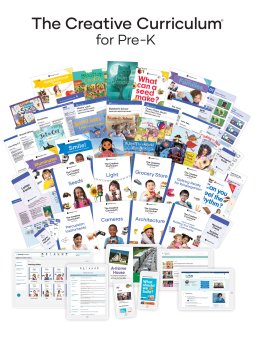
Adult-supported cooperative activities are frequently included in both structured plans in ITEs and open-ended classroom interest areas. The use of project-based learning through studies (Percussion Instruments, Architecture, Light, Cameras, Grocery Store, Seeds) invites children to investigate open-ended questions or problems to discover more about each topic.
The materials address a wide variety of scenarios, vignettes, and other examples of “teacher talk” that offer suggestions on ways teachers can effectively communicate and build positive relationships with children. Scenarios guide the adult in reflecting on the scenario and in determining next steps for engaging with each child to continue building trusting relationships.
Overall, The Creative Curriculum for Pre-K consistently embeds structured routines, explicit social–emotional guidance, and responsive teacher language, creating frequent opportunities for children to build trust, feel emotionally safe, and engage in meaningful communication with adults. Because these features are practical and integrated across materials, the curriculum meets the indicator for supporting positive relationships and interactions with adults.
Indicator 1.1b
Curriculum materials support collaborative partnerships with families by fostering communication and coordinating home-school learning.
The Creative Curriculum for Pre-K materials meet expectations for supporting collaborative partnerships with families (1.1b).
These supports are embedded throughout the year and appear across multiple components of the materials, demonstrating both frequency and intentionality. The materials also provide structured opportunities for family input. The materials emphasize respectful, strengths-based family engagement and give teachers concrete strategies, tools, and resources to connect learning to home.
The Curriculum Guide, Partnering With Families (pp. 31–33) describes strengths-based approaches for welcoming families, learning about their values, and fostering communication.
The section Communicating With Families (p. 32) outlines formal and informal communication methods teachers can use throughout the year.
In Volume 1: The Foundation Chapter 5: Partnering With Famili, on these ideas are expanded upon and a detailed list of “Ways to Communicate With Famili, is provided, supporting teachers in establishing inclusive communication routines.
The materials include a beginning-of-the-year questionnaire (available in English & Spanish). These opportunities appear consistently across studies and allow teachers to incorporate families’ voices into planning and instruction meaningfully.
Each study also includes practical at-home activity suggestions aligned with weekly classroom content. These activities are developmentally appropriate, connected to study objectives, and designed to reinforce learning through family participation. Weekly family letters, available in English, Spanish, and other languages, introduce study topics, summarize weekly learning, and provide simple, actionable home activities. Their consistent appearance demonstrates both frequency and high quality.
The materials include SmartTeach, a digital platform that provides extensive digital tools to strengthen home–school connections. It includes a digital children’s library with more than 100 titles and learning activities in English and Spanish.
The Teaching Strategies Family App enhances two-way communication by allowing teachers to send messages, reminders, and activity ideas aligned with current studies. Families can respond directly and access a digital children’s library. Activities may be selected by teachers or automatically aligned to the study, making it easy for families to extend classroom learning at home.
Every study includes a bilingual Letter to Families that explains the upcoming topic, invites contributions of free or low-cost materials, and encourages family members to share relevant expertise or experiences.
Digital Family Playlists link directly to each investigation question within each study and can be shared via the Family App, text, or email (in English or Spanish). Each playlist includes simple, play-based activities using common household materials.
Family Letters describing classroom interest areas are also available in Volume 2: Interest Areas, included at the end of each chapter. These letters outline what children learn in each area and provide related at-home activities.
Throughout the Teaching Guides, embedded “Family Partnerships” suggestions help teachers involve families in daily learning. Examples include:
From the Architecture Study Teaching Guide, p. 21: inviting families to submit photos of meaningful community buildings.
From the Cameras Study Teaching Guide, p. 57: posting classroom charts in the family area so families can see what children investigated that day.
From the Seeds Study Teaching Guide, p. 77: inviting families to bring birdseed or photos of bird feeders.
Family conferences are strongly emphasized as a key strategy for communication and collaboration. Teachers are encouraged to share progress, ask for family insights, and co-develop goals, creating plans and giving families a copy (Volume 1: The Foundation: p. 211). The curriculum also includes Intentional Teaching Experience LL72, “Conference Conversations,” which guides teachers in involving children in preparing for their family conference. Materials do not indicate that information about student progress is shared in families' preferred languages.
Overall, The Creative Curriculum for Pre-K materials provide comprehensive support for fostering collaborative family partnerships through consistent guidance, multilingual letters, flexible communication tools, digital resources, structured home–school activities, and opportunities for families to meaningfully participate in studies and classroom learning. The curriculum’s tools for communication, coordinated home–school learning, and culturally responsive family engagement ensure that families are valued partners in supporting children’s development and learning.
Indicator 1.1c
Curriculum materials are culturally and linguistically responsive, reflecting and valuing learners’ diverse backgrounds and languages.
The Creative Curriculum for Pre-K materials partially meet expectations for cultural and linguistic responsiveness (1.1c).
The materials emphasize that classrooms should “honor children’s diverse backgrounds, cultures, and experiences”. Volume 1: The Foundation, Chapter 1 (pp. 54–55) discusses culture, provides questions for teachers to reflect on, and offers ways to learn about families. Materials include English–Spanish transadaptations available across key resources, including the Foundation volumes, Teaching Guides, Intentional Teaching Experiences, Mighty Minutes, and Book Discussion Cards. These transadaptations preserve cultural meaning rather than simply translating text, supporting Spanish-speaking children’s cultural and linguistic identities.
Guidance in Volume 1: The Foundation (pp. 198-199) includes a list of questions to ask during enrollment to learn more about the family.
Are there any special traditions, celebrations, or songs that are especially important to your family and your child?
How would you like us to support your family’s values and culture at school?
How can I learn more about your heritage and culture?
Are you willing to share something about your family’s heritage with the program?
Teachers are encouraged to consider children's family backgrounds, heritage, and culture when selecting materials that support children’s work and play. For example, in Volume 2: Interest Areas, the materials suggest a wide variety of ways for teachers to honor each family and promote children’s awareness of, respect for, and participation in their family’s heritage, culture, and traditions. The addition of these culturally and linguistically responsive classroom materials promotes developmentally appropriate, culturally relevant role-play and problem-solving while also helping children and families share important practices with other children in the class.
Two-way family communication tools within the platform invite families to contribute photos, recipes, stories, and traditions that can be integrated into classroom learning. These features promote meaningful cultural exchange between home and school.
Across studies, there are flexible cultural entry points, such as exploring foods in the Grocery Store study, global instruments in Percussion Instruments, traditional celebrations in Light, and architectural styles in Architecture. These topics naturally lend themselves to cultural inclusion. However, the Teaching Guides do not consistently provide explicit cultural examples; instead, teachers must rely on family contributions or their own adaptations to bring cultural perspectives into instruction.
The materials offer moderate guidance for culturally responsive teaching practices. Volume 1: The Foundation Chapter 5, encourages teachers to learn about children’s backgrounds through home visits, family interviews, and ongoing communication. Teachers are prompted to incorporate home languages, traditions, artifacts, and family stories into classroom routines. The Building Your Classroom Community guide further encourages inviting families to share songs, stories, and celebrations. While supportive, this guidance remains general and is not uniformly incorporated into all studies.
The materials also provide suggestions for creating culturally responsive environments, such as displaying family photos, labeling areas in multiple languages, and incorporating familiar objects from home. However, visuals and concrete examples are limited, and several studies lack diverse images, representation of varied family structures, and depictions of children with disabilities. The curriculum’s strong bilingual supports primarily focuses on English and Spanish, with less representation of other cultural or linguistic groups.
Overall, The Creative Curriculum for Pre-K materials demonstrate a clear commitment to honoring children’s diverse backgrounds and offer strong foundational guidance that encourages teachers to learn about and incorporate family cultures and languages. However, explicit cultural examples are not consistently embedded across all studies, and many opportunities require significant teacher initiative to bring cultural and linguistic perspectives into daily instruction.
Indicator 1.1d
Curriculum materials are respectful of differences and designed to challenge prejudice, promote fairness, and foster compassion.
The Creative Curriculum for Pre-K materials partially meet expectations for being respectful of differences, challenging prejudice, promoting fairness, and fostering compassion (1.1d).
Across Volume 1: The Foundation and Volume 2: Interest Areas, the materials emphasize creating a classroom community where all children feel safe, valued, and capable. Volume 1 guides teachers in learning about children’s cultural and family backgrounds and in integrating these into routines, while Volume 2 reinforces fairness by encouraging teachers to adapt classroom practices for children with diverse identities and abilities. These references appear multiple times, demonstrating a consistent expectation for inclusive and compassionate practice.
Guidance in Volume 1: The Foundation emphasizes self-awareness in Chapter 5, “Partnering with Families.” Here, teachers are encouraged to critically reflect on their own identities, cultures, and experiences, and on how their background shapes their interactions with others. This reflective practice provides a necessary foundation for recognizing and respecting differences, addressing bias, and establishing equitable classroom environments. Additionally, the section on individual differences (pp. 48–63) provides concrete strategies and guiding questions that help teachers acknowledge the diverse dimensions of identity—such as temperament, culture, language, and life experiences—present within their classrooms.
The materials' vision statements highlight building a community that honors each child’s background, culture, and experiences. This is reinforced in the First Six Weeks Teaching Guide, which includes routines that model empathy, fairness, and respect, such as greeting children in home languages, co-creating class rules, and establishing predictable routines that help every child feel included. These components set a compassionate tone for the school year.
The materials include differentiation and individualization tools to support fairness and equity. These include accommodations for children with disabilities, strategies for multilingual learners, and English–Spanish transadapted resources that preserve cultural meaning rather than providing direct translations. The Intentional Teaching Cards (e.g., SE06 Talk About Feelings, ITC M22 Sorting Objects, Mighty Minutes 26 Clap With Me) also include adaptations that promote participation for children with varied linguistic or motor needs.
Overall, The Creative Curriculum for Pre-K provides a range of resources and strategies that support fairness, compassion, and respect for differences. The materials include guidance for creating inclusive classroom environments, encouraging teacher reflection, and adapting instruction to meet diverse needs, including supports for multilingual learners and children with disabilities. There are also developmentally appropriate activities and routines that promote empathy, respect, and appreciation for cultural differences. While these elements offer a meaningful foundation, the range and consistency of supports for addressing prejudice and fully reflecting diverse cultural and linguistic perspectives are more moderate, with opportunities for deeper and more systematic integration across the curriculum.